

When something goes wrong in a business, the first explanation you hear is rarely where the investigation should stop.
A proposal goes out late.
A customer disappears.
An invoice does not get sent.
A material order is missed.
An employee makes a mistake.
Someone asks what happened, gets an answer, and moves on.
That is usually too early.
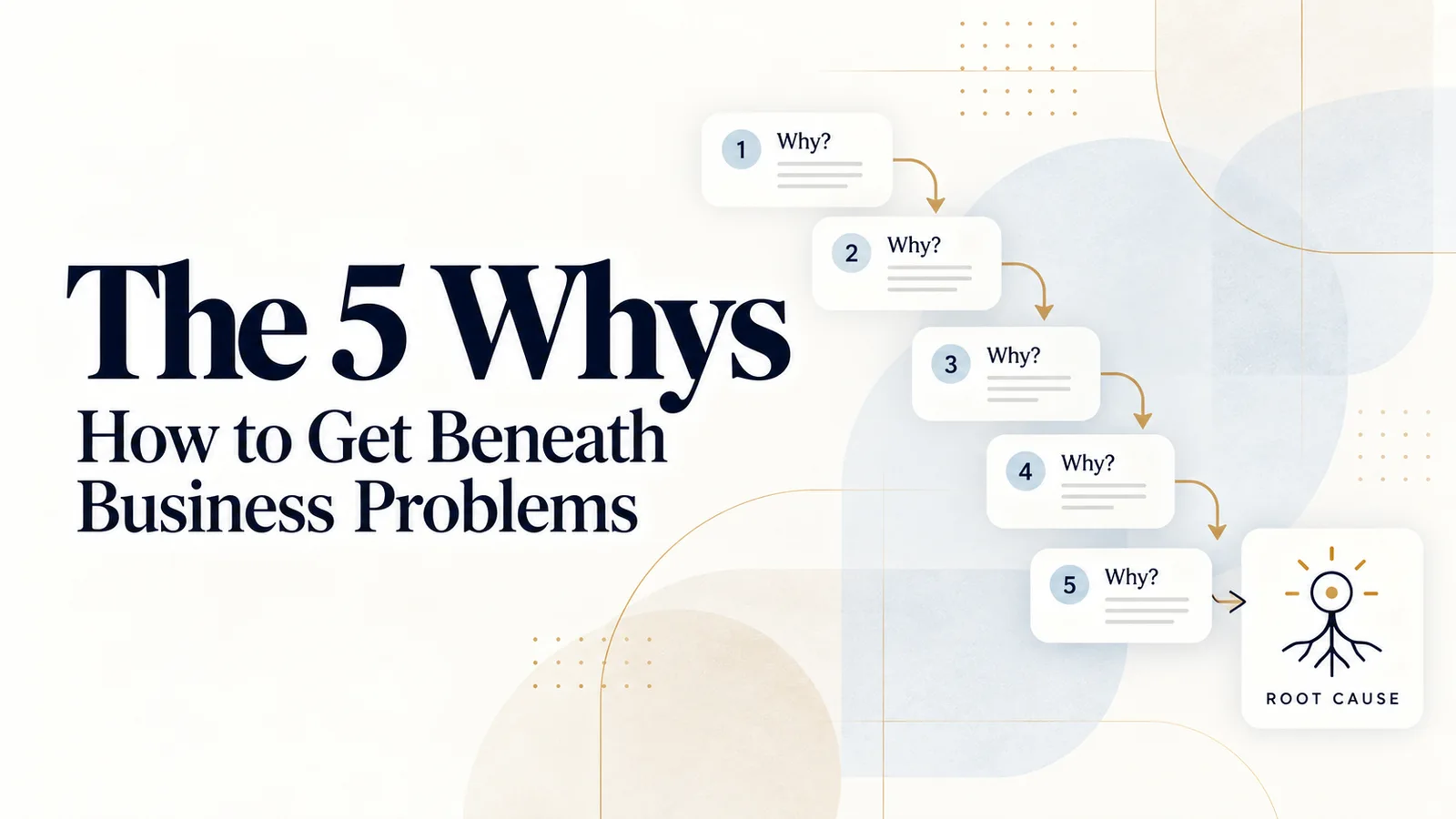
The 5 Whys is a simple method for getting underneath the visible problem and understanding what actually produced it.
The basic pattern is:
“Why did that happen?”
“Because X.”
“Okay. Why did X happen?”
“Because Y.”
“Okay. Why did Y happen?”
Each answer becomes the subject of the next question.
Keep going until you reach something useful enough to act on.
A Simple Example
Problem:
“The proposal went out late.”
Why did that happen?
“Estimating didn’t finish it in time.”
Okay. Why did THAT happen?
“They were waiting for supplier pricing.”
Why was the supplier pricing late?
“The requests didn’t go out until late in the process.”
Why did that happen?
“Nobody realized they hadn’t been sent.”
Why did that happen?
“We don’t have a standard kickoff process that assigns and tracks supplier pricing requests.”
Now you have something useful.
The original problem was:
“The proposal was late.”
The first explanation was:
“Estimating was late.”
If management stops there, the response might be:
“Estimating needs to be faster.”
But that does not necessarily fix anything.
After continuing to ask why, the problem looks different:
There is no reliable process for assigning and tracking supplier pricing requests when an estimate begins.
That is something the business can actually change.
Ask Why About the Answer You Just Received
This is the most important part of the method.
Do not keep asking why about the original problem.
Ask why about the answer you just received.
The conversation should move like this:
“Why did this happen?”
“Because X.”
“Okay. Why did X happen?”
“Because Y.”
“Okay. Why did Y happen?”
“Because Z.”
You are following the chain downward.
That is different from asking:
“Why was the proposal late?”
and getting five separate answers:
- estimating was behind
- engineering changed something
- a supplier was late
- someone was away
- the customer changed the scope
Those may all matter, but that is more like brainstorming possible causes.
The 5 Whys is about taking one cause and following it deeper.
Do Not Stop at Convenient Answers
Some answers sound like explanations, but they are often only the next layer of the problem.
For example:
“The employee didn’t know.”
Okay. Why didn’t they know?
“They weren’t trained.”
Why weren’t they trained?
“We assumed their manager had shown them.”
Why was it based on an assumption?
“We don’t have a documented onboarding checklist.”
The employee genuinely did not know.
That part may be completely true.
But the more useful business problem may be the lack of a reliable onboarding process.
The same thing happens with answers like:
- poor communication
- human error
- lack of accountability
- too busy
- poor planning
- someone forgot
- employee mistake
These phrases may describe what happened.
They often do not explain why it happened.
If you hear one, ask why again.
“Poor communication.”
Why was communication poor?
“People weren’t keeping each other updated.”
Why weren’t they?
“There wasn’t a scheduled project meeting.”
Why wasn’t there one?
“Our project setup process doesn’t establish a recurring meeting cadence.”
Now you have something concrete.
Do Not Stop at “Someone Forgot”
This one deserves special attention because businesses use it all the time.
Someone forgot.
Okay.
Why was the process dependent on someone remembering it?
If something is important enough that the business cannot afford to forget it, perhaps there should be:
- a checklist
- a reminder
- an automated trigger
- a required field
- an approval step
- a recurring task
- a defined responsibility
- a standard operating procedure
The question changes from:
“How do we make people remember?”
to:
“How do we build a process that doesn’t depend entirely on memory?”
That is a much stronger management question.
Human beings forget things.
If an important process succeeds only when someone remembers one small step at exactly the right time, the process may be fragile.
Avoid Turning It Into Blame
The 5 Whys should not become:
“Which employee screwed this up?”
The point is to understand how the business produced the outcome.
For example:
“John forgot to send the invoice.”
Why?
“He didn’t realize the job was complete.”
Why?
“Nobody told accounting that the field work had finished.”
Why?
“There is no automatic handoff between operations and accounting.”
You could tell John:
“Remember next time.”
Maybe he will.
But the condition that allowed the problem to happen is still there.
A better solution might be to change the workflow so accounting is automatically notified when a job moves to Complete.
That does not mean employees are never responsible for mistakes.
It means the goal should be to prevent the next occurrence, not just identify who was involved in the last one.
Follow One Thread at a Time
Sometimes when you ask why, you will get several answers at once.
For example:
Why was the proposal late?
“Engineering took longer than expected, we were waiting for supplier pricing, and the estimator was pulled onto another project.”
Those may all be legitimate contributors.
But do not investigate all three at the same time.
Pick one.
Write down the others so you do not lose them, then follow one thread.
For example:
Why was the proposal late?
“We were waiting for supplier pricing.”
Why was the supplier pricing late?
“The requests went out too late.”
Why did that happen?
“Nobody realized they had not been sent.”
Why did that happen?
“There is no standard estimating kickoff process that assigns and tracks supplier requests.”
Finish that thread.
Then go back to the others:
- engineering took longer than expected
- the estimator was pulled onto another project
Each of those can become its own investigation.
This matters because it is easy for these conversations to become scattered.
Someone mentions supplier pricing.
Someone else mentions engineering.
Then workload comes up.
Then staffing.
Then scheduling.
Five minutes later, everyone is discussing six different things and nobody has actually followed one of them very far.
Stay on one path.
Follow it until you reach a useful stopping point.
Then go back and investigate the next branch.
Problems Can Have More Than One Branch
Following one thread at a time does not mean every business problem has one perfectly linear cause.
Often there are several.
Suppose you ask:
Why was the project late?
The answer is:
“Engineering took longer than planned and procurement started late.”
Those are two different branches.
Write them both down.
Then investigate them separately.
Branch 1
Why did engineering take longer?
“Because the requirements changed.”
Why did the requirements change?
“Because they were not confirmed with the customer before design began.”
Branch 2
Why did procurement start late?
“Because purchasing did not know the drawings had been released.”
Why didn’t purchasing know?
“Because there is no formal design-to-procurement handoff.”
You may discover several underlying problems rather than one magical root cause.
That is fine.
The purpose is understanding, not forcing reality into a neat diagram.
Five Is Not a Rule
Despite the name, you do not need to ask “why” exactly five times.
Sometimes you uncover the useful problem after three questions.
Sometimes it takes six or seven.
Do not stop simply because you have asked why five times.
And do not keep asking pointless questions just to reach five.
Keep going while each question is producing a deeper and more useful explanation.
Stop when you reach something the business can reasonably act on, or when another why is no longer giving you useful insight.
The number five is not the important part.
The habit of continuing beyond the first explanation is.
Another Example: “The Customer Ghosted Us”
Imagine a salesperson says:
“We lost the customer.”
Why?
“They stopped responding.”
Why did they stop responding?
“They weren’t seeing enough value in continuing the conversation.”
Why?
“We hadn’t given them anything specific enough to make a decision on.”
Why?
“We didn’t have the information required to prepare a recommendation.”
Why?
“The salesperson never completed discovery.”
Why was the opportunity able to progress without completed discovery?
“Our sales process doesn’t define what information must be collected before an opportunity moves to the proposal stage.”
You started with:
“The customer ghosted us.”
You ended with:
“Our sales process allows opportunities to move forward without completed discovery.”
That is much more useful.
The customer may still have ghosted you.
But now the business has something it can improve.
Fix the Lowest Useful Level
Think of the chain like this:
Problem
↓
Immediate explanation
↓
Underlying explanation
↓
Process failure
↓
Systemic cause
You do not need to keep digging forever.
You are looking for the lowest useful level.
The point where you can make a meaningful change.
There is a big difference between:
“Tell estimating to send supplier requests sooner.”
and:
“Every estimate begins with a kickoff checklist that assigns supplier requests, gives them due dates, and tracks whether they have been sent.”
One depends on people trying harder.
The other changes how the business operates.
Fixing something near the top of the chain may solve today’s incident.
Fixing something lower in the chain may prevent an entire category of incidents.
The Simple Habit
The 5 Whys is not complicated.
You do not need special software.
You do not need a workshop.
You do not need a complicated root-cause framework.
You just need to stop accepting the first explanation as the end of the conversation.
Something goes wrong.
Ask:
“Why did that happen?”
Listen to the answer.
Then ask:
“Okay. And why did THAT happen?”
Follow that answer.
Stay on one thread.
Write down other branches and come back to them later.
Keep going until you understand what in the business actually produced the outcome.
Very often, the visible failure is only the last link in a much longer chain.
The purpose of the 5 Whys is to find the part of that chain worth fixing.