

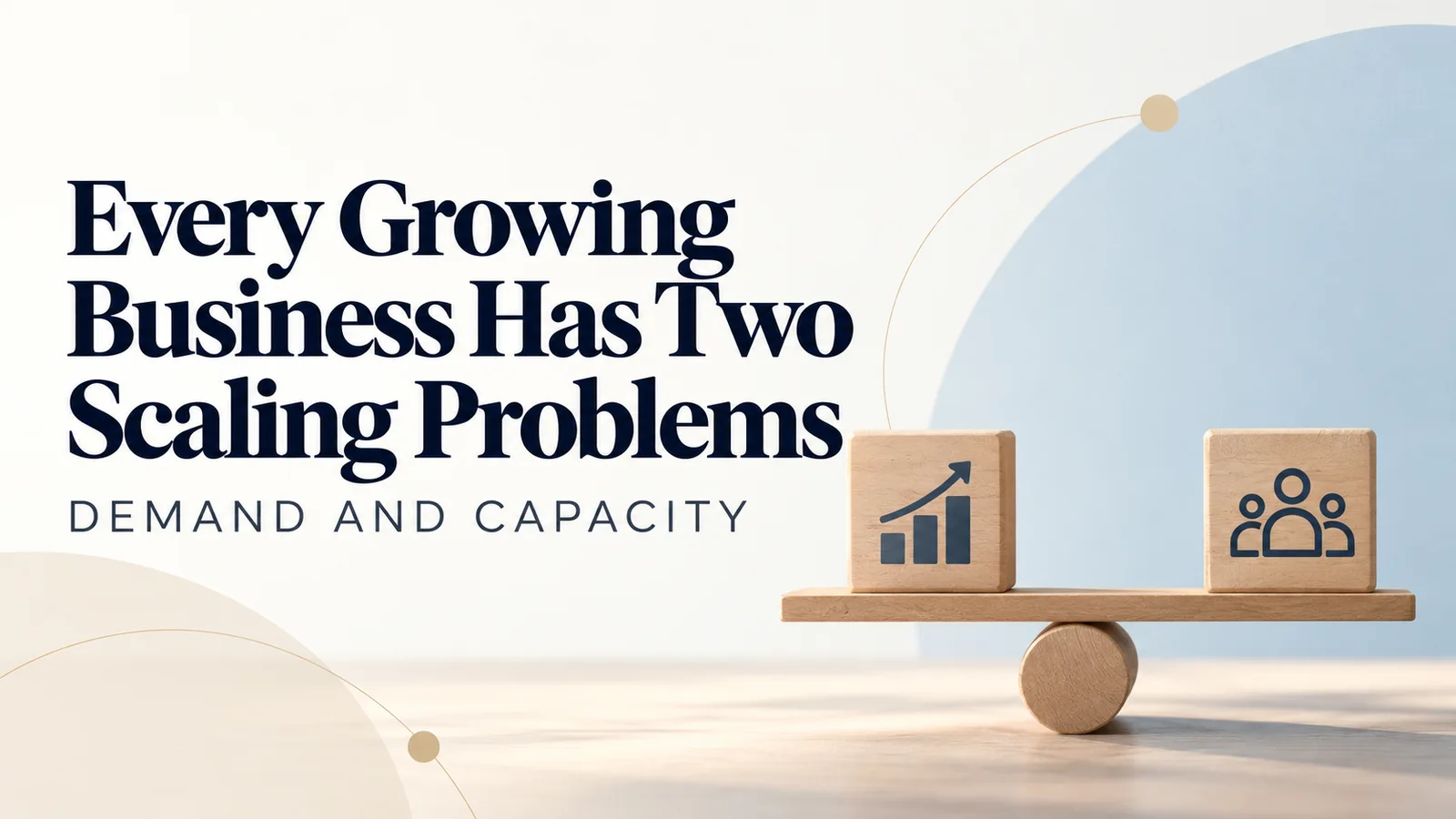
Business owners talk about “scaling” as though it is one problem.
It usually is not.
One of the biggest challenges of scaling a business is that growth depends on two separate systems expanding at roughly the same time.
The first creates demand.
The second creates the capacity to fulfill that demand.
Those systems are related, but they are not the same. Understanding the difference makes it much easier to diagnose what is actually limiting the growth of a company.
If your team has unused capacity and not enough work, you probably have a demand problem.
If good opportunities are available but you cannot reliably deliver more work, you probably have a capacity problem.
And if the owner is personally responsible for solving both problems, you may have an owner leverage problem.
TL;DR
A growing business has to scale two things at once: demand and delivery capacity. Demand brings enough of the right work into the company. Capacity gives the company the people, systems, processes, management and resources required to deliver it reliably.
When one falls behind the other, growth stalls. The mistake is treating the imbalance as one generic “growth problem” instead of identifying which side is actually constrained.
The First Scaling Problem: Demand
Every business needs enough suitable work coming through the door.
That is the job of the demand side of the company.
Depending on the business, this might include marketing, sales, business development, customer relationships, estimating, proposals, lead generation, account management, or some combination of them.
The important word is not simply “more.”
It is suitable.
A business does not benefit from filling its pipeline with work that is unprofitable, outside its expertise, strategically undesirable, or difficult to deliver.
The demand side of the company is responsible for creating enough of the right opportunities.
At its simplest, the question is:
How much good work can we bring into this company?
As the business grows, that becomes a scaling problem of its own.
- Can we generate more qualified leads?
- Can we build a stronger pipeline?
- Can we enter a new market?
- Can we create repeatable sales processes instead of relying entirely on the owner’s relationships?
- Can we develop customers who buy from the company rather than simply buying from the owner?
Those are demand-scaling questions.
The Second Scaling Problem: Capacity
Winning more work is only useful if the company can actually deliver it.
That is the second scaling problem.
Capacity is not simply the number of employees a business has.
It is the practical ability of the organization to deliver more work reliably.
That may involve hiring, but it can also involve:
- Better processes
- Training and onboarding
- Improved scheduling
- New equipment
- Better management
- Stronger quality control
- More effective delegation
- Better documentation
- Technology and automation
- Clearer roles and accountability
A company with 30 employees can sometimes have less usable capacity than a well-organized company with 20.
The capacity side of the business is therefore asking a different question:
What needs to change so we can reliably deliver more?
That distinction matters because the answer to a capacity problem should not automatically be to stop creating demand.
Diagnose the Problem Before Trying to Fix It
One useful way to think about growth is to ask which side of the company is currently constrained.
If you have employees, equipment, or production capability sitting idle, you probably have a demand problem.
You have capacity available. The business needs more suitable work to use it.
If the sales pipeline is healthy but the company is constantly delaying work, turning opportunities away, missing deadlines, or overloading employees, you probably have a capacity problem.
There is enough demand.
The organization needs to expand its ability to deliver.
This sounds obvious when written down.
In practice, companies often blur the two together.
Someone says, “We are too busy,” and the response is to slow down sales.
Or someone says, “We need more revenue,” and the response is to sell aggressively without addressing the operational problems already developing underneath the business.
Both reactions can create problems.
Growth becomes easier to manage when you identify which machine actually needs attention.
The Dangerous Mistake: Letting Today’s Capacity Determine Tomorrow’s Demand
Imagine a business sees a promising new market.
There appears to be significant demand. The work fits the company’s capabilities. Margins look attractive. Existing customers may already be asking for it.
Someone raises the opportunity internally.
The immediate response is:
“We couldn’t handle that right now.”
That may be completely true.
But it does not necessarily mean the company should walk away from the opportunity.
The better question may be:
What would have to change for us to handle it?
Would we need another crew?
Another manager?
Different equipment?
Better training?
A stronger scheduling process?
A new supplier?
A different operating system?
Six months to build the capacity?
Those are very different questions from simply asking whether the company can handle the work today.
A growing business gets into trouble when it allows its present delivery capacity to define its future demand.
Today’s capacity is a constraint.
It should not automatically become a strategy.
A Capacity Problem Should Not Automatically Become a Sales Problem
This distinction can be surprisingly powerful.
When demand exceeds capacity, organizations sometimes solve the imbalance by slowing the demand side down.
Stop marketing.
Stop prospecting.
Turn away opportunities.
Tell the sales team not to sell quite so much.
Sometimes that is temporarily necessary. There are real limits to how quickly a business can safely expand.
But it should be a deliberate decision.
Otherwise, an operational limitation has quietly become a sales strategy.
The business is no longer asking:
“What opportunities should we pursue?”
It is asking:
“What opportunities fit inside the organization exactly as it exists today?”
Those are not the same thing.
The first question is strategic.
The second is constrained by the present.
Why Demand and Capacity Eventually Need Separate Accountability
As an owner-led business grows, I think demand and capacity should eventually have different accountable leaders.
Not because the two sides should operate independently.
Quite the opposite.
They need to work closely together.
But separating accountability creates productive tension.
The sales or demand leader can say:
“There is a lot more good work available.”
The operations leader can respond:
“To deliver that amount of work reliably, we need two additional people, another manager, and a better scheduling process.”
Leadership can then decide:
“Is this where we want the company to go?”
That is a useful conversation.
The alternative is often more subtle.
If the same person owns both demand and operations, they naturally see every sales opportunity through the lens of today’s operational limitations.
They may see a promising opportunity and immediately think:
“We don’t have the capacity.”
“We don’t have the people.”
“We are already too busy.”
And because they are accountable for both sides, the easiest solution is often to throttle demand.
No conflict occurs.
But no one is really challenging the current capacity of the company either.
Separate accountability prevents today’s operational limitations from quietly becoming tomorrow’s growth ceiling.
The Tension Is the Point
The demand leader and operations leader should not always agree.
In fact, some disagreement is useful.
The demand side should be finding opportunities that occasionally stretch the organization.
The operations side should be identifying what would be required to service those opportunities reliably.
That does not mean sales should promise anything it wants and throw the problem over the wall to operations.
Nor does it mean operations should be forced into reckless growth.
The tension exists so that the company can make explicit decisions.
Demand asks:
What opportunities exist?
Operations asks:
What would it take to deliver them?
Leadership asks:
Should we make that investment?
That is a much healthier growth conversation than simply allowing whoever feels busiest to determine how large the company should become.
The Owner May Temporarily Lead One of These Functions
Of course, most owner-led businesses do not begin with two executives sitting beneath the owner.
The owner probably performs both roles at first.
They generate work.
They deliver work.
They hire people.
They solve problems.
They manage customers.
They make almost every important decision.
Over time, parts of those responsibilities begin moving to other people.
Often, operations is one of the first major functions to receive dedicated management.
The owner may continue leading sales and business development.
That can make sense for quite a while.
Owners often have advantages that are difficult to replicate.
They have credibility.
They understand the market.
They know the company’s capabilities.
They have relationships.
They can make decisions quickly.
They can communicate the vision of the business better than almost anyone else.
So an owner can be extremely effective at generating demand.
But that does not necessarily mean the owner should permanently be responsible for leading the demand side of the company.
Being Good at Sales Is Different From Leading Sales
The problem is often not skill.
It is consistency.
The owner may be the best salesperson in the company and still be a poor long-term sales leader.
Because the owner has another job.
A customer problem escalates.
An employee quits.
A major financial decision needs to be made.
A new partnership opportunity appears.
An operational issue requires attention.
A strategic decision cannot be delegated.
The owner’s attention moves constantly.
Sales and marketing leadership, meanwhile, require consistency.
Pipeline reviews need to happen.
Follow-ups need to happen.
Marketing needs direction.
Opportunities need to be developed.
Processes need to improve.
People need coaching.
When the owner is also the company’s escalation point for everything else, those activities are easily interrupted.
The problem is not that the owner is incapable of leading sales.
The problem is that the organization is still relying on the owner’s personal attention to keep one of its two major growth systems functioning.
That is an owner leverage problem.
Growth Requires Two Machines
A healthy growing business is continually expanding two things.
Demand.
And capacity.
Demand reveals where capacity needs to grow.
New capacity creates room for additional demand.
More demand reveals the next constraint.
The company adapts again.
The cycle continues.
There will rarely be perfect balance.
Sometimes demand will temporarily lead capacity.
Sometimes capacity will be built ahead of demand.
That is normal.
The important thing is recognizing that these are two different systems with two different jobs.
When people are sitting idle, ask how to create more suitable demand.
When worthwhile opportunities exceed what the company can reliably deliver, ask how capacity needs to change.
Do not automatically solve a capacity problem by reducing ambition on the demand side.
And do not solve a demand problem by adding capacity nobody needs.
The Owner’s Job Eventually Changes
Early in a business, the owner is often both machines.
They create demand and figure out how to deliver it.
That works because the business is small enough for one person to hold much of the system together.
As the company grows, that approach becomes increasingly difficult.
The owner’s role has to change.
Instead of personally creating all the demand and personally solving every capacity problem, the owner begins building accountable functions that can do both.
One leader expands demand.
Another expands the organization’s ability to deliver.
The owner increasingly operates above those systems.
Where should we grow?
Which opportunities are worth pursuing?
Where should we invest?
What risks are acceptable?
What capacity should we build?
What is preventing the company from moving forward?
Those are different questions from the ones the owner asked when they were personally doing the work.
And that is part of the progression from running the business to directing it.
That progression still depends on staying connected to what implementation teaches. In Keep the Head and the Hands Close Together, I make the related argument that leaders should create distance from routine work without becoming insulated from the reality created by that work.
Growth requires two machines.
One creates demand.
The other creates the capacity to fulfill it.
The owner’s job is not to become both machines.
It is to build them, give each clear accountability, and keep them moving in the same direction.