

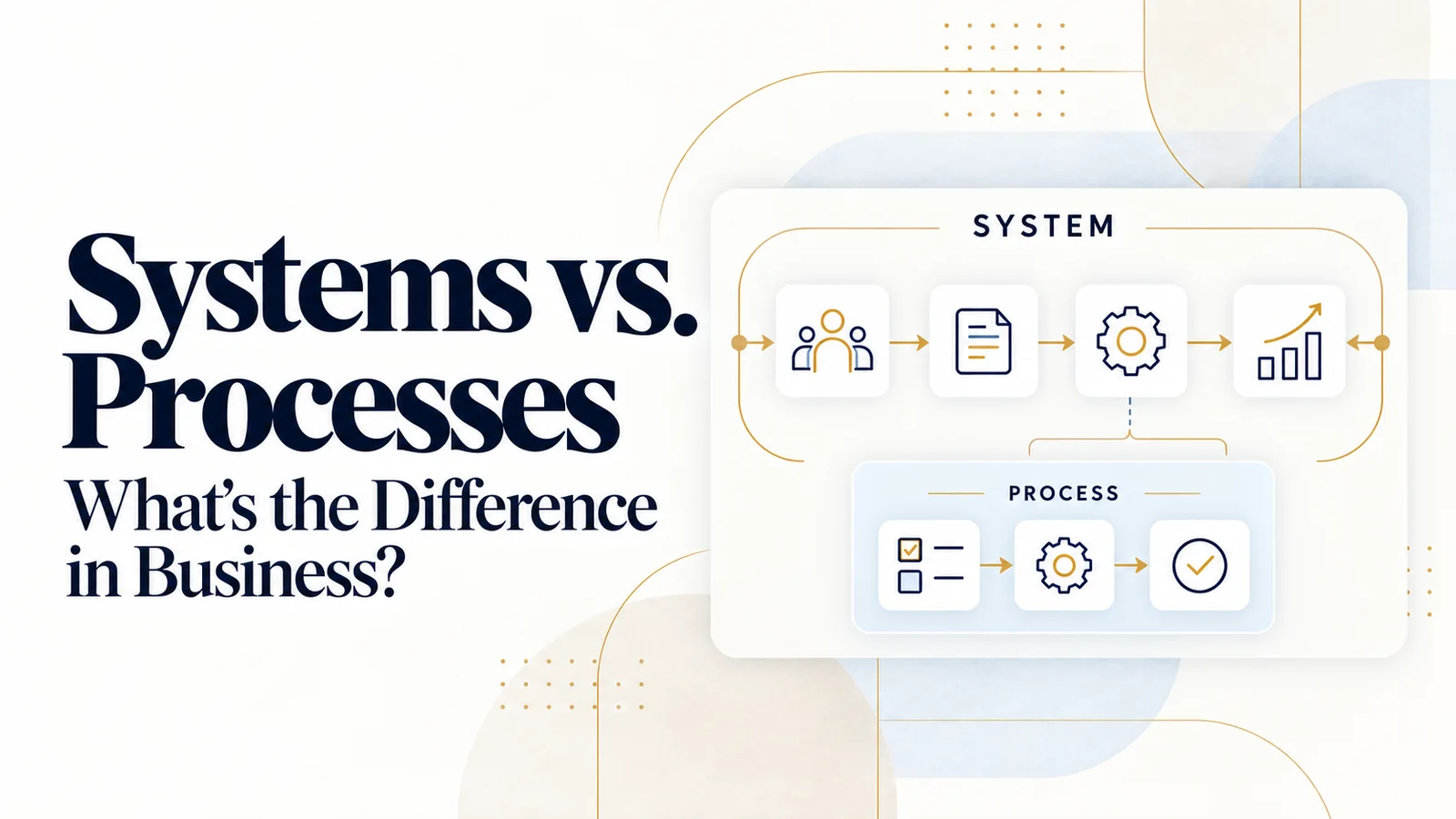
The words system and process are often used interchangeably in business. While they are closely related, they serve different purposes.
At Infinite Leverage, we believe understanding this distinction is important when building a business that operates consistently, scales effectively, and does not depend on the owner for every decision.
Let’s break down the difference and how these concepts fit within BOSS (Business Operating System & Standards).
What Is a System?
A system is the overall structure that organizes how a particular function of the business operates.
It defines the workflow, responsibilities, stages, and how work moves from beginning to end.
A system is not necessarily software or an application. It is the organized way your business accomplishes something.
Examples of business systems include:
- Sales System
- Marketing System
- Hiring System
- Project Management System
- Customer Service System
A well-designed system establishes how work enters the business, who is responsible for it, how it progresses, and what happens when it is completed.
What Is a Process?
A process is a specific sequence of actions performed within a system to accomplish a particular task or outcome.
While a system organizes the overall function, processes describe how individual activities within that system are completed.
Processes give structure to repeatable work, helping employees understand what needs to happen and in what order.
Example: The Sales System
Let’s look at how systems and processes work together.
A business might have a Sales System that moves opportunities through six stages:
Lead → Qualify → Estimate → Proposal → Follow-up → Close
That’s the system. It establishes the overall workflow for turning prospective customers into paying customers.
Within that system are several processes:
- Lead Qualification Process: How the business determines whether an opportunity is worth pursuing.
- Estimating Process: How pricing is developed and reviewed.
- Proposal Preparation Process: How proposals are prepared and delivered.
- Follow-up Process: How outstanding opportunities are managed.
- Contract Signing Process: How an accepted proposal becomes a confirmed project.
Each process supports the larger Sales System.
Different businesses might use different processes or stages. What matters is that the system provides a clear, repeatable structure for how the work gets done.
How Systems, Processes, SODs, and Controls Fit Within BOSS
Within BOSS, we distinguish between four related concepts.
| Element | Purpose |
|---|---|
| System | Organizes how work flows. |
| Process | Defines the steps for completing part of that work. |
| SOD (Standard Operating Document) | Documents the instructions, standards, and knowledge needed to perform the work. |
| Control | Monitors whether the system is performing as expected. |
Let’s return to our Sales System example.
The system organizes opportunities through the sales pipeline.
The processes define how employees qualify opportunities, prepare estimates, and follow up with customers.
SODs provide the supporting documentation, such as estimating procedures, proposal templates, qualification criteria, and company policies. Capturing this knowledge also supports our Only Answer Once philosophy.
Controls provide visibility into performance, such as the number of outstanding proposals, conversion rates, and average response times. But controls should inform judgment rather than become goals in themselves, a distinction we explore in When the Measurement Becomes the Goal.
Together, these elements help the business operate consistently while giving managers and owners the information they need to make better decisions.
Having Processes Doesn’t Mean You Have a System
This is an important distinction.
A company can have dozens of beautifully documented processes without having a functioning system.
You might have an excellent estimating SOP, a proposal template, and a detailed follow-up checklist.
But what happens when a new lead arrives?
Who receives it? Who decides whether it is worth pursuing? When does it move to estimating? Who follows up? How does management know when opportunities are being neglected?
If those questions don’t have clear answers, the company may have documented processes, but it doesn’t necessarily have an effective Sales System.
A system isn’t simply a collection of SOPs.
It needs to organize the work, establish responsibilities, connect activities, and make execution repeatable.
And importantly, a system shouldn’t create unnecessary bureaucracy. The purpose is to make work easier and more reliable, not to introduce rules for the sake of having rules.
Building a Business That Doesn’t Depend on You
This distinction matters because many owner-led businesses operate through the owner’s personal knowledge and involvement.
The owner knows which leads are important, who should prepare an estimate, when to follow up, and which opportunities deserve attention.
The business functions because the owner keeps everything moving.
But as the business grows, that approach becomes increasingly difficult to maintain.
At Infinite Leverage, our goal is to help owner-led businesses become values- and systems-driven, allowing owners to spend less time directing everyday activities and more time focusing on strategy, growth, and company well-being.
Through BOSS, we help turn scattered knowledge, decisions, processes, and expectations into a structured operating framework the team can actually use.
The objective isn’t to document everything or create complicated procedures.
It’s to establish enough structure that the right work gets done, by the right people, with the right information, without requiring the owner’s constant involvement.
The Bottom Line
The distinction is simple:
A system organizes the work. A process describes how a particular piece of that work gets done.
Processes make individual activities repeatable. Systems connect those activities into a functioning operation. SODs preserve the knowledge required to perform the work, and Controls help measure whether it is working.
When these elements work together, your business becomes less dependent on individual people remembering what to do and more capable of operating through an established structure.
That’s the foundation of BOSS, and an important step toward building a business that can grow beyond its owner.