

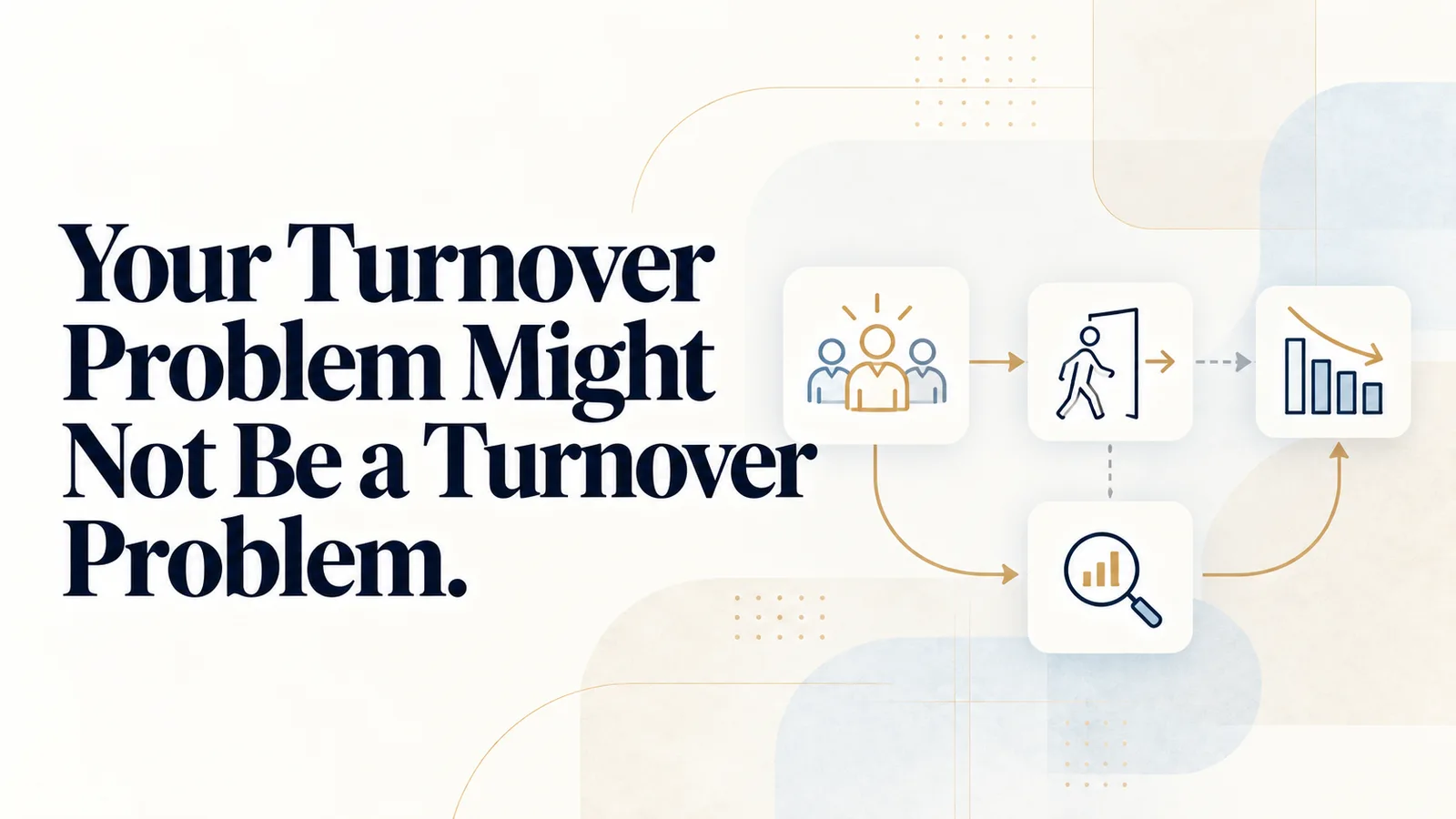
When employee turnover starts increasing, it is tempting to treat turnover as the problem.
Maybe compensation needs to improve.
Maybe benefits need to change.
Maybe employees want more flexibility.
Maybe morale is low.
Maybe the company needs better engagement programs, better communication, more team events, or a new retention strategy.
Any of those things could be true.
But turnover is not really a problem by itself.
It is a signal.
And before you start building solutions around that signal, it is worth figuring out what it is actually telling you.
Sometimes your business does not have a turnover problem.
Sometimes you have one person making everyone else miserable.
And sometimes that person is the owner.
A Metric Is Not a Diagnosis
Businesses naturally turn complicated things into numbers.
Revenue.
Margin.
Utilization.
Absenteeism.
Turnover.
That is useful. Good businesses need controls that tell leadership what is happening.
But a control is different from a diagnosis.
If turnover rises from 10 percent to 20 percent, you have learned something important: more people are leaving.
You have not learned why.
Nobody quits because the company’s turnover rate reached 20 percent.
One person quits because they cannot stand their manager anymore.
Someone else quits because every interaction with a particular coworker becomes an argument.
Another employee likes the company and likes the work, but has slowly lost confidence because every decision gets second-guessed.
Another gets tired of priorities changing every week.
Another leaves because of compensation.
And another leaves because of the owner.
Eventually, those individual decisions get grouped together in a spreadsheet and become “turnover.”
The danger starts when we take an aggregate metric and assume it must have an aggregate cause.
Then a company-wide retention strategy gets created to solve a problem that may be sitting in one office.
Follow the Problem Upstream
One of the most useful habits in running a business is separating symptoms from causes by following the problem upstream.
If sales are declining, “we need more leads” might be the answer.
Or it might not be.
Perhaps leads are fine and the sales process is broken.
If projects are constantly late, “we need more staff” might be the answer.
Or perhaps decisions are taking too long, responsibilities are unclear, or one bottleneck is slowing down every project.
Turnover works the same way.
High turnover is a symptom.
The useful question is not simply:
“How do we reduce turnover?”
It is:
“Why are these particular people leaving?”
Those questions lead to very different actions.
The first can easily produce a new policy.
The second requires investigation.
Owners Do Not Experience Employees the Same Way Their Coworkers Do
There is another reason this problem can be difficult for an owner to see.
Owners usually experience employees vertically.
You see whether someone produces results.
You know whether they answer your calls.
You see whether they solve problems.
You know whether they are dependable.
You may know that they bring in a lot of revenue, keep projects moving, or seem deeply committed to the company.
Their coworkers experience them horizontally.
They sit through meetings with them.
They wait for their answers.
They have ideas dismissed by them.
They deal with their temper.
They hear the complaining.
They clean up the messes.
They work around their habits.
They hear what gets said after leadership leaves the room.
Those are two very different perspectives on the same person.
An owner can sincerely think:
“Sarah is one of the best people we have.”
The people working beside Sarah can sincerely think:
“I don’t know how much longer I can work with Sarah.”
Both can be true.
As leaders move farther from the day-to-day work, that perspective gap becomes easier to miss. It is one of the reasons to keep the head and the hands connected through a strong feedback loop.
Leaders naturally evaluate people based on what those people contribute directly.
But direct contribution is only part of someone’s impact on a company.
Measure Organizational Drag, Not Just Individual Output
Businesses are usually much better at measuring individual output than organizational drag.
Imagine someone who appears to be an exceptional performer.
They produce excellent work.
They hit their numbers.
They respond quickly when the owner needs something.
They take responsibility.
They solve difficult problems.
On a performance report, they look fantastic.
But people avoid asking them questions because every conversation becomes confrontational.
Meetings become quieter when they enter the room.
Employees stop bringing forward half-formed ideas because they know those ideas will immediately be criticized.
Information starts flowing around them instead of through them.
Good employees become frustrated.
Eventually, some leave.
That employee may still be producing excellent individual results while reducing the output of the organization around them.
That is organizational drag.
And it can be remarkably expensive while remaining almost invisible in traditional performance measurements.
A great salesperson can make the sales team worse.
A brilliant engineer can make an engineering department worse.
A highly productive project manager can make everyone on the project less effective.
Individual productivity and organizational value are not always the same thing.
Managers Have Even More Leverage
The effect becomes larger when the person creating the problem is a manager.
A difficult coworker can make someone’s day unpleasant.
A difficult manager can influence almost everything about someone’s working life.
Workload, priorities, opportunities, decision-making authority, schedule, compensation, feedback, confidence and advancement can all flow through that person.
Yet managers are often primarily evaluated from above.
Leadership sees the department’s numbers.
Employees experience how those numbers are being produced.
A manager can hit every target and still leave behind an exhausted, defensive team.
In fact, strong short-term results can sometimes hide the problem.
The department performs.
The manager looks effective.
People quietly leave.
New people get hired.
The department performs again.
More people leave.
Eventually someone says, “We seem to have a retention problem.”
At that point, it is worth looking for the recurring variable.
Sometimes it is not the employees.
It is the manager.
And Sometimes the Recurring Variable Is the Owner
Owners should not exempt themselves from this analysis.
That is difficult because we experience our own behaviour through our intentions.
Other people experience it through its consequences.
An owner thinks:
“I have high standards.”
The employee experiences:
“Nothing I do is good enough.”
The owner thinks:
“I move quickly.”
The employee experiences:
“The priorities change every few days.”
The owner thinks:
“I stay involved.”
The employee experiences:
“I am not trusted to make decisions.”
The owner thinks:
“I am direct.”
The employee experiences:
“Every mistake becomes embarrassing.”
The owner thinks:
“I push people because I know what they are capable of.”
The employee experiences:
“I dread talking to the owner.”
Sometimes both descriptions contain truth.
The point is not that owners should surrender their standards or manage entirely according to employee perception.
The point is that intentions do not eliminate consequences.
If capable people repeatedly leave the same part of the business, reporting to the same person, or after experiencing the same pattern, that deserves investigation.
Even when the pattern leads back to you.
The Founder Does Not Have to Be the Manager
There is also an assumption worth questioning in owner-led companies.
Ownership and management are not the same job.
Someone can be an exceptional entrepreneur and an average people manager.
They can be brilliant at sales, strategy, product development, technical work, relationships or identifying opportunities.
None of that automatically means they should have 40 people reporting through them.
As a company grows, the role where the founder creates the most value can change.
At an earlier stage, being involved in everything might have been necessary.
Later, the same behaviour can become a bottleneck.
The business may eventually outgrow your ability to manage it before it outgrows your ability to contribute to it.
That is not necessarily a failure.
Recognizing it may be part of successfully moving from owning your job to actually directing a company.
Build a Better Turnover Control
The answer is not to stop measuring turnover.
The answer is to make the control more useful.
Instead of recording only how many people leave, look for the patterns underneath the number:
- Who is leaving, where did they work, and who did they work with?
- Who did they report to?
- Are departures clustered around a team, manager, location, role or period of rapid change?
- What reasons do departing employees actually give, and do those reasons repeat?
- Are good employees becoming quieter, less willing to make decisions, or increasingly dependent on management before they leave?
- Does a supposed “top performer” consistently appear somewhere in the story?
- What would employees say about working beside their coworkers, working for their managers, and working for the owner?
Now turnover becomes more than an HR statistic.
It becomes a business control.
And a good control does not just tell you that something is wrong.
It helps you find where to look.
Fix the Cause, Not the Metric
There are legitimate company-wide causes of turnover.
Compensation can be wrong.
Benefits can be poor.
People can be overworked.
Roles can be unclear.
There can be no opportunity for advancement.
The culture itself can be unhealthy.
Those problems deserve systemic solutions.
But the opposite mistake is equally dangerous.
Not every recurring problem needs another policy.
Not every employee issue requires a company-wide initiative.
Not every retention problem requires better benefits.
Sometimes the system is telling you about a very specific problem.
The job of leadership is to find it.
Before changing compensation, introducing another engagement program, reorganizing the company or buying everyone pizza, ask a simpler question:
“What is actually causing good people to leave?”
Then follow the answer as far upstream as it goes.
It might lead to a policy.
It might lead to a manager.
It might lead to one employee.
And every once in a while, it might lead back to the owner.
That is what business controls are supposed to do.
Not just tell you what happened.
Help you see what needs your attention.
This article builds on an idea first explored on Jeremiah Vanderlaan’s personal blog in “Your Business Might Not Have a Turnover Problem. It Might Have a ‘One Shitty Individual’ Problem.” Infinite Leverage takes that idea one step further: how owners can use signals like turnover to identify the underlying problems inside their businesses.